


Trophies, Trust and Argentina: Why Lionel Scaloni is the World Cup's Most Underrated Coach
Lionel Scaloni won the World Cup, back-to-back Copa Americas and changed how Argentina play. So why does nobody talk about him? Here is the full story of the coach who rebuilt a nation.


In Pujato, Santa Fe province of Argentina, there are roughly 4,000 people. It is a small farming town where almost everyone knows everyone, and where a young boy once grew up kicking a ball around before moving to Rosario at 15 to join the Newell's Old Boys academy.
That boy, Lionel Scaloni, is now the coach of the Argentine national team. He has won the World Cup, two Copa Americas, and a Finalissima. He is, by any fair reading, the most successful Argentina coach in a generation. Most casual football fans could not pick him out of a lineup. And that is almost the whole point.
When Argentina crashed out of the 2018 World Cup in Russia, losing to France in the round of 16 amid reports of a squad divided against their own coach Jorge Sampaoli, the Argentine Football Association was in a mess. The president of the AFA, Claudio 'Chiqui' Tapia, needed someone to take charge of the national team for a set of friendlies while a proper search for a new manager got underway.
He turned to Scaloni, who had been working as an assistant to Sampaoli and before that had logged a handful of games in charge of Argentina's Under-20 side. Scaloni had never been a senior head coach. His playing career, a solid if unspectacular run as a right-back at Deportivo La Coruña, a loan spell at West Ham, and later stints at Lazio, Racing Santander, and Atalanta before retiring in 2015, did not make him an obvious name.
Diego Maradona, watching from outside, bluntly said that Scaloni could not manage traffic, let alone the national team.
The AFA handed him a rolling six-month contract as a placeholder.
What he did when nobody was watching
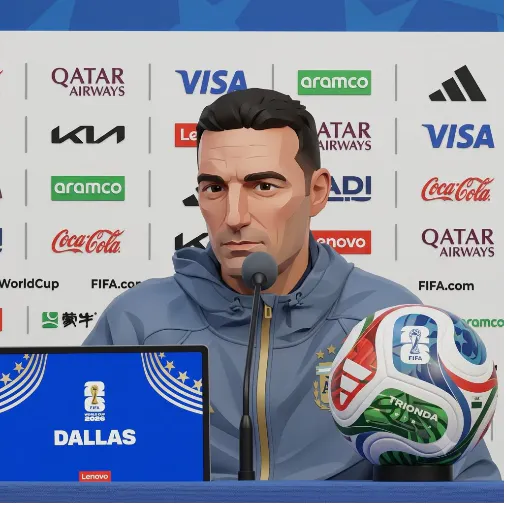
Before Scaloni called a player, he picked up the phone and rang Lionel Messi, who had by that point retired from international football twice and come back twice, was in a complicated place with the fanbase. The Argentine press had spent years calling his generation 'The Friends Club', a group of overrated millionaires who won everything at club level and disappeared on the international stage.
Public trust in Messi and his teammates was at its lowest point in years.
Scaloni told Messi he wanted him in the squad and asked how he was. The Barcelona legend laughed, said he was happy, and wished him well. According to those around the conversation, the tone of the whole relationship was set in those few minutes. Scaloni never made Messi feel like he owed Argentina anything. He made him feel wanted.
That sounds like a small thing. In that dressing room, at that moment, it was enormous.
Inside the squad itself, Scaloni did the same with everyone else. Rodrigo De Paul, one of the key players in the years that followed, admitted later that there was real mistrust when Scaloni first walked in. Nobody was sure what he stood for or how long he would last. Scaloni's answer was not a speech. It was consistency. He told each player, clearly and individually, what their role was. He did not hide behind vague team-talk. He gave people specific jobs and specific reasons. Players who expected a temporary manager found themselves in one of the most settled environments Argentine football had seen in years.
The 2019 Copa America in Brazil was a third-place finish. On the surface, that was not a great result. But Scaloni was doing something important that most people missed. He was working out which players actually fit together, which combinations worked under pressure, and where the character in the group was.
He had inherited a squad full of talents who had never quite clicked as a unit. His job, as he saw it, was not to impose a system on them. It was to find a shape that made them feel like a team.
He got there. The 2021 Copa America final, played at the Maracanã in Rio de Janeiro, put Argentina against Brazil on Brazilian soil. Brazil were the hosts, the favourites, and the team that had knocked Argentina out in the semifinal two years earlier. Argentina won 1-0. Messi lifted his first major trophy as a senior international player. The scenes after the final whistle showed that Scaloni had built a group with a real identity and a real bond.
The unbeaten run around that period stretched to 36 matches, the longest in Argentina's history. They won the Finalissima against Italy in 2022, beating the European champions 3-0 at Wembley. No doubts, Scaloni had assembled one of the most consistent international teams on the planet.
Qatar 2022
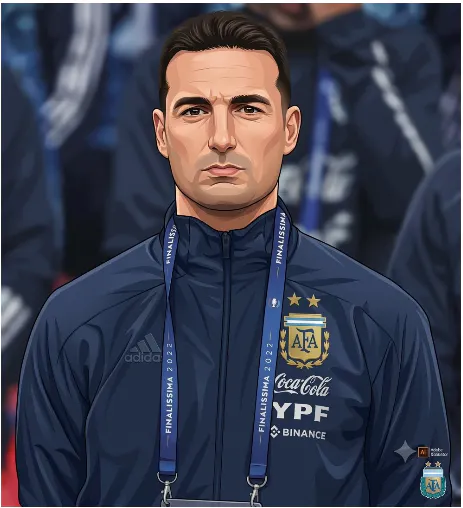
The 2022 World Cup in Qatar opened with one of the biggest upsets in tournament history. Argentina, ranked number one in the world, lost their first group game 2-1 to Saudi Arabia. It was the kind of result that had ended campaigns and coaching careers before. Scaloni did not publicly panic, did not shuffle the squad in a way that suggested fear, and did not let the noise outside the camp get inside it. Argentina won their next two group games against Mexico and Poland, came through a tense last-16 against Australia, and then produced a quarterfinal win over the Netherlands that involved one of the most dramatic penalty shootouts the tournament has seen.
The final against France was something else entirely. Argentina led 2-0, France pulled it back to 2-2 in the last ten minutes through an Mbappe brace, the match went to extra time, Argentina scored again, France equalised again through Mbappe's hat-trick goal, and it ended 3-3.
Penalties. Argentina won. Scaloni, watching from the touchline, barely moved. Where other coaches wave their arms and bark instructions in shootouts, he stood still. His players had the information they needed. He trusted them to use it.
He won the Best FIFA Men's Coach award for 2022. IFFHS named him the best men's national coach in the world. Back in Argentina, the conversation about whether he should be sainted had already started. In Pujato, they named a street after him.
The Scaloni method
Scaloni is not a tactical purist in the way Guardiola or Bielsa are. He does not build everything around one identity and demand that opponents adapt to it. What he does, and does better than almost any other international coach right now, is read his players and read the game in front of him, and make the two fit together.
His preferred formation shifts between a 4-3-3 and a 4-4-2 depending on the opponent and the game state. In possession, Argentina use positional rotations in midfield to pull the opposition's shape out of place, creating passing lanes that then open space for the forwards. Out of possession, the team drops into two compact banks of four. This is intelligent football, built for winning tournaments over seven matches, not for winning style points.
When it comes to squad selection, his assistant Roberto Ayala revealed the process at this World Cup: every member of the coaching staff submits their own list independently. Scaloni collects them, opens a group discussion, and then makes the final call himself. The staff usually disagree on one or two names at most. The process is calm, informed, and collective, without being a committee. This is 'the scaloni method.'
At this World Cup, Argentina are aiming to become the first nation since Brazil in 1962 to defend the trophy. Messi, at 38, is still the captain and still the player the system is built to serve. His hat-trick in the opening group win over Algeria, his ongoing involvement as a creative hub even as his body demands more careful management, and Scaloni's handling of his fitness across the tournament all reflect the same relationship that started with that phone call in 2018.
Scaloni has been mentioned in conversations about club jobs in Europe, including Real Madrid after the 2026 tournament. He has said before that he would like to coach in Europe someday, that Lazio, where he played, has a place in his heart. Whether that happens any time soon or not, it will not change what he has already done.
The man Maradona said could not manage traffic has won the World Cup, two Copa Americas, a Finalissima, and produced Argentina's longest unbeaten run in 65 years. He did it without fanfare, without a big reputation, and without needing anyone outside the squad to believe in him. In a sport that endlessly rewards noise, Scaloni's career is a case for the opposite.
WHAT YOU SHOULD READ NEXT

Ronaldo vs Messi: career goals, trophies, Ballon d'Or wins and the GOAT debate
Cristiano Ronaldo reached 973 career goals winning the Saudi Pro League with Al Nassr. Lionel Messi has 910 goals, eight Ballon d'Ors and 46 trophies at Inter Miami. Here is the full GOAT breakdown as both men continue playing in 2026.

Escort parties, laughing gas and a Serie A scandal: The new Theo Hernandez allegations explained
Fabrizio Corona has published allegations naming Theo Hernandez as the alleged organiser of escort parties involving several AC Milan players, some reportedly held the night before matches. Here is the full picture of what is being claimed and what it means for Italian football.

Pep Guardiola vs Sir Alex Ferguson: Football's greatest managers compared
Trophies, records, legacy, players developed. A full breakdown of where Pep Guardiola and Sir Alex Ferguson stand in the argument for the greatest football manager of all time.

Al-Ahli are accusing referees of handing Cristiano Ronaldo the trophy
Ivan Toney and Galeno have accused Saudi Pro League officials of fixing the title race for Cristiano Ronaldo's Al-Nassr, after three uncalled penalties in Al-Ahli's 1-1 draw with Al-Fayha. The England international now faces a potential ban that could end his World Cup hopes.
Comments (0)
Latest Posts

Eberechi Eze Stats and Biography: Progress or Regression?

Manchester City 115 Charges Ruling: 3 Reasons They May Not Be Punished As You Expect

The Complete Midfielder - Who Is the Best Right Now?

Lamine Yamal vs Raphinha: Who Is the Better Player at Barcelona?

Goals, Trophies and Loyalty: Inside the World of Lionel Messi

FIFA World Cup 2026 Prize Money: How Much Spain, Every Team, and Player Won
🔥 Most Read
More from this Author

Lamine Yamal Childhood in the Spotlight: Inside a Modern Prodigy’s Rise

AFCON 2027 Qualifiers: Diomande, Ghana and 5 Reasons You Should Watch This Year’s Edition

Max Dowman, England and the price of being ready too early

Never Change a Winning Team: Arsenal, Arteta and a Lesson Relearned the Hard Way

Alidu Seidu, Nice and the Joker Rule: How Ligue 1 Lets Clubs Sign Players After the Window Closes

