


Gabriel Martinelli, Brazil & World Cup: Has Arteta wrongly profiled the Arsenal Winger?
Martinelli scored Brazil's World Cup winner against Japan. It puts fresh focus on how Arteta has used him at Arsenal across six seasons.


Gabriel Martinelli scored the goal that sent Brazil into the World Cup round of 16 on Monday, a 95th-minute strike off the bench that turned a 1-1 draw with Japan into a 2-1 win. Carlo Ancelotti called it Brazil's most complete performance of the tournament and singled out Martinelli afterwards.
“Martinelli has a lot of intensity as a player, he is always in his top game,” the Brazil coach told reporters. That came at a rather interesting time, given how his club season at Arsenal actually went.
Martinelli played 1,073 minutes in the Premier League for Arsenal in the 2025/2026 season. One goal, four assists, regular spells out of the matchday squad entirely. Compare that to 2022-23, when he scored 15 league goals in 36 appearances and shared Arsenal's top scorer prize with Martin Odegaard during the title run that finished second behind Manchester City.
That season remains the high point of his Arsenal career. Xhaka was still in midfield then, Zinchenko was the inverted left-back, and the front line built around Martinelli's pace looked unstoppable on its day.
Martinelli is right-footed playing the left wing, the classic inverted setup that lets him cut onto his stronger foot and shoot or thread passes through the inside channel. Where he separates from most modern inverted wingers, Vinicius, Leao, Kvaratskhelia included, is that he doesn't rely too much on tight 1v1 footwork to beat a man. His game is built on straight-line speed, a recorded top speed above 36 kilometres per hour, and constant off-ball movement that drags fullbacks deeper before he attacks the space behind them.
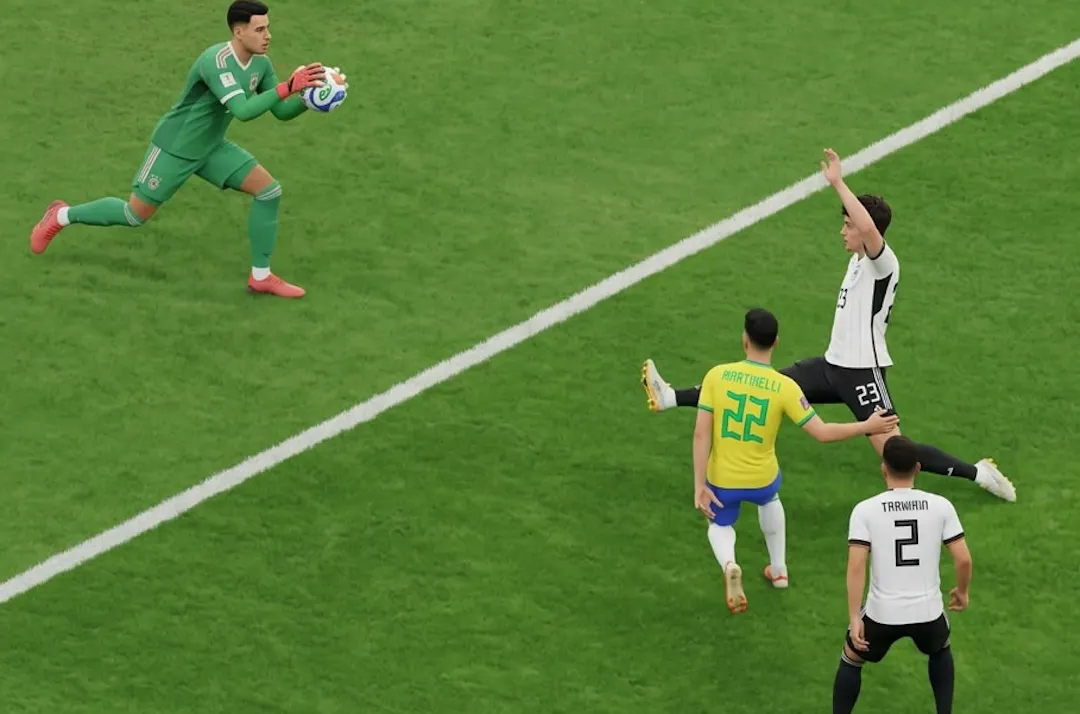
Martinelli stretches the width of the pitch deliberately in build-up, body open, ready to either receive on the ball and drive at a defender or sprint in behind once the line drops off. He also attacks the byline far more than a typical inverted winger would, opening his body on the touchline, rolling the ball with his instep, and crossing with his left foot when a cutback isn't on.
That straight-line burst and byline directness gives him a profile closer to an old-fashioned wide forward than a pure cut-inside playmaker, even while he plays from the left.
His defensive workload sets him apart too. Martinelli presses, drops in to help the left-back out of possession, and recovers the ball high up the pitch more often than almost any other forward in the league. None of that shows on a highlight reel, but it explains why Arteta has trusted him through six full seasons even during lean spells. The work rate has never been the question. The end product has.
The Profile Question
Arteta has reshaped almost every attacking player who has come through his Arsenal. Xhaka went from a deep-lying passer to an advanced midfielder who scored regularly in his final season at the club. Saka started as an emergency left-back and became one of the best wide forwards on the planet. Ben White moved from centre-back to right-back. Martinelli is part of that pattern too, lifted from a central striker role in his early Arsenal days into the left-wing slot where he made his name, but unlike Xhaka or Saka, his role has stayed almost frozen since 2022-23 while the rest of the position has changed around him.
Arsenal signed Noni Madueke and Eberechi Eze last summer, both relatively comfortable on the left, both seen by many pundits as more reliable end product threats.
Gary Neville said on The Overlap that Madueke “looks a hell of a player” on the opposite flank and questioned whether Martinelli could even hold his spot.
Arteta has used the Brazilian as a rotation option for spells this season rather than an automatic starter, something unthinkable three years ago. Yet every time he has come off the bench, the equaliser against Manchester City in September among the clearest examples, the difference has been obvious within minutes.
RELATED POST

Why Martinelli thrives for Brazil at the World Cup
For the Seleção, Martinelli gets isolated centrally and against the backline far more in a national team setup, attacking the space between centre-backs rather than getting boxed in on the touchline by a settled low block. Arsenal's left side under Arteta has often asked him to hold width and wait, particularly against teams who sit deep, which suits Saka's mirror role on the right far better than it suits Martinelli's straight-line game.
None of this means Arteta got it wrong in 2022-23. That season worked because Xhaka and Zinchenko rotated through the left half-space constantly, dragging markers and opening the kind of central running lanes Martinelli thrives in.
Once Zinchenko's role faded and Arsenal's structure tightened into the patient, position-disciplined approach Arteta has built since, the space that made Martinelli so dangerous narrowed with it. He didn't get worse as a player; the pitch around him changed shape, and his role never adjusted to match it.
Brazil face Norway in the round of 16, and Ancelotti has a real selection decision on whether Martinelli starts or stays an impact option. Either way, the Japan winner puts a spotlight back on a debate Arsenal fans have been having. Martinelli at his best is still one of the most dangerous wide forwards in Europe. The question Arteta has to answer is whether Arsenal's current setup gives him any real chance of getting there.
WHAT YOU SHOULD READ NEXT

Premier League, Pride and Priorities | Players, Fans and a Global Divide
Premier League’s LGBTQ+ inclusion campaigns, the players’ controversies, and the cultural tensions among its global fanbase.

France's new Ligue 3 explained: What it is, how it works and why it matters
France's Championnat National becomes Ligue 3 from the 2026-27 season, making it the country's first fully professional third-tier league. Here is a full explainer on the format, governance, broadcast deal, salary cap and what changes for clubs below.

Escort parties, laughing gas and a Serie A scandal: The new Theo Hernandez allegations explained
Fabrizio Corona has published allegations naming Theo Hernandez as the alleged organiser of escort parties involving several AC Milan players, some reportedly held the night before matches. Here is the full picture of what is being claimed and what it means for Italian football.
Comments (0)
Latest Posts

Eberechi Eze Stats and Biography: Progress or Regression?

Manchester City 115 Charges Ruling: 3 Reasons They May Not Be Punished As You Expect

The Complete Midfielder - Who Is the Best Right Now?

Lamine Yamal vs Raphinha: Who Is the Better Player at Barcelona?

Goals, Trophies and Loyalty: Inside the World of Lionel Messi

FIFA World Cup 2026 Prize Money: How Much Spain, Every Team, and Player Won
🔥 Most Read
More from this Author

Lamine Yamal Childhood in the Spotlight: Inside a Modern Prodigy’s Rise

AFCON 2027 Qualifiers: Diomande, Ghana and 5 Reasons You Should Watch This Year’s Edition

Max Dowman, England and the price of being ready too early

Never Change a Winning Team: Arsenal, Arteta and a Lesson Relearned the Hard Way

Alidu Seidu, Nice and the Joker Rule: How Ligue 1 Lets Clubs Sign Players After the Window Closes

