


Kylian Mbappe: When football is no longer just about football
Goals and trophies no longer define a superstar alone. From Mbappe's World Cup headlines to Vinicius Junior's Ballon d'Or controversy, modern elite footballers are judged on everything, including who they are off the pitch.


After France beat Paraguay 1-0 in the round of 16, Kylian Mbappe refused to shake hands with goalkeeper Orlando Gill at the final whistle. Gill responded by throwing the ball at his back. Paraguay senator Celeste Amarilla then posted a racist tirade on social media, calling the French footballer a "colonised Cameroonian pretending to be French" and writing things that drew condemnation from France's president, FIFA, and the French Football Federation, which has since filed a legal complaint.
Game ended, Paraguayan goalkeeper is trying to shake hands with Mbappe, but he clearly ignored the guy.
— TobyWrites (@tobyasky) July 4, 2026
Was there something up??
Mbappe responded with a statement, defending himself and, pointedly, the Paraguay players who had nothing to do with the senator's words.
Within 24 hours, a match that France won because of Mbappe's penalty had become primarily a story about everything except the penalty. That is the world the modern superstar lives in.
At 27, the France international is one of the most statistically outstanding forwards in the history of the sport. He scored 25 La Liga goals last season, claimed back-to-back Pichichi trophies, and has accumulated 431 career goals across 573 appearances for club and country. His Transfermarkt valuation consistently places him among the two or three most valuable players alive.
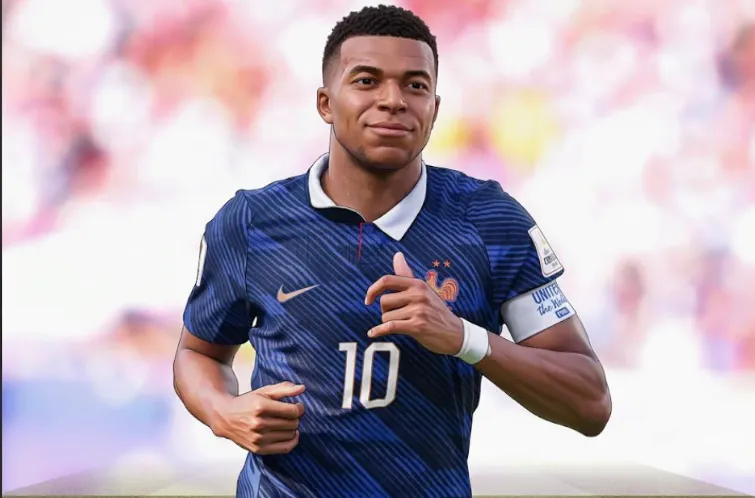
At World Cup, he now has 19 career goals, second only to Messi on the all-time list, and is the leading scorer in France's history. For context, his run from Paris through Monaco, PSG, and now Real Madrid at 1.78m and a physique built for explosive straight-line speed has long attracted attention from clubs across Europe, including, in his academy years, Chelsea, where he had trials before committing to Monaco. The jersey he wears, No. 10 for France, carries the full weight of what that number means in French football. None of that has been the focus of this week's conversation.
This week was entirely outside his control. But it shows, with almost uncomfortable clarity, the environment today's elite players actually operate in.
When public perception begins to write the story
The 2024 Ballon d'Or vote gave us one of the most heated arguments that award has generated in years. Vinícius Júnior had finished the season as arguably the most decisive forward in European football: he scored 24 goals for Real Madrid, won the Champions League, and was the standout player across Los Blancos' run to Wembley. The footballing case for him was strong. Rodri won the award instead, recognised for his role in Manchester City's Premier League triumph and Spain's Euro 2024 victory.
What made the result so contentious are the statistics. Vinicius had spent years at the centre of racist abuse in Spain. La Liga stadiums had produced monkey chants directed at him on multiple documented occasions. He had been targeted at least 16 times by racist incidents across his career in Spain, broke down in tears in interviews, threatened to campaign for Spain to be stripped of the 2030 World Cup, and publicly called for perpetrators to be jailed.
Real Madrid boycotted the Ballon d'Or ceremony altogether. A member of Vinicius's management team said afterwards that "the football world is not ready to accept a player who fights against the system."
Whether that cost him the award or not, nobody can say definitively. Rodri had his case. But the conversation around his loss was inseparable from his public battles. His image, shaped partly by abuse he did not invite, had become part of the story. That has consequences beyond individual awards. Sponsors assess it, broadcasters frame narratives around it, and award voters absorb it, consciously or not.
Talent, from all indications, is only a starting point.
Lamine Yamal, for instance, is 18. By any measure, he is one of the most gifted players to emerge in European football in a generation. Barcelona's Hansi Flick has said consistently that the player's talent is "amazing." His performances for Spain in competitive football have justified every comparison made about his ceiling.
RELATED POST

But over the past 12 months, Yamal's name has appeared in headlines that had nothing to do with his left foot. His 18th birthday party drew a formal complaint from the Association of People with Achondroplasia and other Skeletal Dysplasias in Spain, who said people with dwarfism were hired as entertainment. A Spanish government official called for an investigation. Yamal denied the characterisation of events and called the coverage an attempt to damage him at a key moment in his career.
Separately, pundits flagged his visible frustration when substituted during Barcelona's La Liga run, with one former coach warning that he was on "a dangerous path" if he did not manage his conduct on the pitch. Former Real Madrid coach Iván Zamorano said he would not sign him specifically because he lacks "the essence" of a player with class and culture, regardless of his ability.
Barcelona protected him, his agent Jorge Mendes defended him, and Flick contextualised the touchline frustration as competitive drive. That is all reasonable. But the noise existed, and at 18, it has already started to shape a perception that will follow him into his peak years.
What this means for how we judge players
The modern superstar is not just a footballer. He is a brand, a public figure, a cultural reference point, and sometimes, whether he wants it or not, a political one. Every post-match interview, every social media account, every moment captured pitchside by a camera, and every decision made in a private space that eventually becomes public feeds into a portrait that runs parallel to the one built on goals and assists.
Some players have understood this and managed it well. Rodri is the obvious recent example. Throughout a season in which he was the best midfielder in the world by almost any measure, he generated almost no non-football coverage. He spoke carefully, led without noise, and let the trophies speak. The contrast with Vinicius was not accidental in how voters framed their choices, fairly or not.
The uncomfortable truth is that two players can produce identical Transfermarkt valuations, identical mbappe stats-level numbers across a season, and arrive at completely different public positions depending on what surrounds those numbers. A refused handshake after a bad-tempered match becomes an international incident. A senator's racist tirade, which Mbappe handled with clarity and dignity, still adds to a week's worth of coverage that overshadows seven goals at a World Cup.
This is not new. It has always existed in some form. What is new is the speed of it, the reach of it, and the permanence of it. A clip from a post-match tunnel in Qatar or a Philadelphia touchline in 2026 exists forever, searchable, shareable, and recontextualised by whoever finds it useful. Legacy used to be built slowly, through decades of accumulated work. Now it is built and damaged in real time, and the two processes run at the same time.
Comments (0)
Latest Posts

Eberechi Eze Stats and Biography: Progress or Regression?

Manchester City 115 Charges Ruling: 3 Reasons They May Not Be Punished As You Expect

The Complete Midfielder - Who Is the Best Right Now?

Lamine Yamal vs Raphinha: Who Is the Better Player at Barcelona?

Goals, Trophies and Loyalty: Inside the World of Lionel Messi

FIFA World Cup 2026 Prize Money: How Much Spain, Every Team, and Player Won
🔥 Most Read
More from this Author

AFCON 2027 Qualifiers: Diomande, Ghana and 5 Reasons You Should Watch This Year’s Edition

Max Dowman, England and the price of being ready too early

Never Change a Winning Team: Arsenal, Arteta and a Lesson Relearned the Hard Way

Alidu Seidu, Nice and the Joker Rule: How Ligue 1 Lets Clubs Sign Players After the Window Closes

Hull City, Maribor and Acun Ilicali: Is This the Future of Football Club Ownership?

